Mountains Explained: Types of Mountains and How They Form

Introduction
Mountains are large natural elevations of the Earth’s surface that rise prominently above their surroundings, usually with steep slopes and significant relief. In geography, mountains matter because they influence climate patterns, control river systems, shape biodiversity, and affect human activities through natural resources and hazards.
Understanding the types of mountains and how they form reveals that these landforms are created through different geological processes, including plate movement, volcanism, and long-term erosion. In this article, you will explore how mountains are formed, the major mountain types, real-world examples from around the globe, and why mountains are so important to both natural systems and human life.
What Is a Mountain?
A mountain is a major landform that rises high above the surrounding terrain, characterized by steep slopes, significant height, and noticeable relief. From a scientific and geographic perspective, mountains are formed by powerful geological processes such as tectonic forces, volcanic activity, and crustal uplift.
Unlike hills, which are lower and more gently sloping, mountains have greater elevation and steeper gradients, while plateaus are elevated areas with relatively flat surfaces rather than sharp peaks. In geography, features such as height above sea level, slope steepness, and local relief are used together to clearly distinguish mountains from other elevated landforms, making mountains some of the most dramatic and influential features on Earth’s surface.
Why Do We Confuse Mountains with Hills, Rocks, and Valleys?
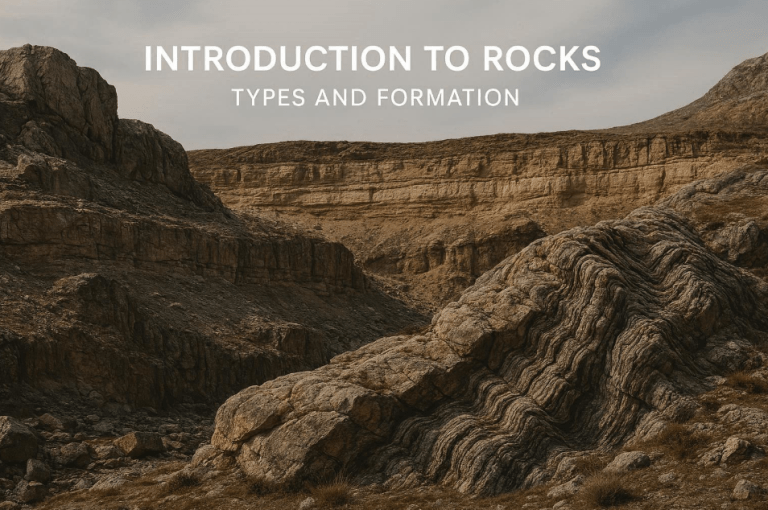
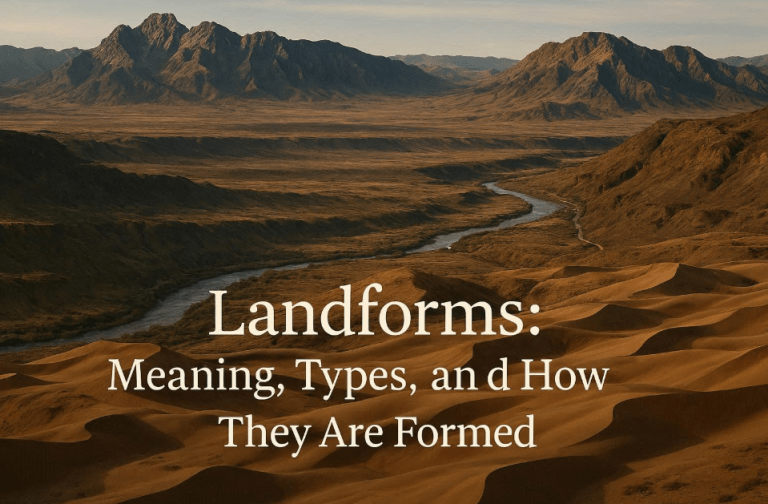
Many people casually refer to any high or rocky area as a mountain, which is why hills, rocks, plateaus, and even deep valleys are often misidentified. In geography, however, each of these landforms has specific defining features based on height, slope, relief, and formation process. Understanding these differences is essential for accurately describing Earth’s surface. If you have ever wondered why a hill is not a mountain or how valleys differ from plains, this confusion will be fully cleared in our upcoming post on landforms, where each major landform is broken down in simple and practical terms.
How Mountains Are Formed: The Geological Processes
Mountains do not appear overnight. They are the result of long-term Earth processes operating deep within the planet and at its surface. The formation of mountains is closely linked to internal forces such as plate tectonics and volcanism, as well as external forces like weathering and erosion. Understanding how mountains are formed helps explain why mountain ranges differ in shape, height, and structure across the world and why they continue to change over geological time.
Plate Tectonics and Crustal Movement
Plate tectonics plays the most important role in mountain formation. The Earth’s lithosphere is divided into large tectonic plates that are constantly moving, though very slowly. When these plates interact, powerful forces are generated that deform the Earth’s crust. At convergent plate boundaries, plates move toward each other, leading to compression and crustal shortening.
This compression causes the crust to fold, buckle, and uplift, forming large mountain ranges such as the Himalayas and the Alps. In some cases, one plate is forced beneath another in a process called subduction, which also contributes to mountain building along continental margins. These tectonic movements explain why many of the world’s highest and youngest mountains are found near plate boundaries.
Volcanism and Mountain Building
Volcanic activity is another major geological process responsible for mountain formation. Volcanic mountains are created when magma from deep within the Earth rises through cracks in the crust and erupts at the surface. As lava, ash, and other volcanic materials accumulate over time, they build up elevated landforms that eventually become mountains.
Repeated eruptions can form massive volcanic peaks such as Mount Fuji and Mount Kilimanjaro. Volcanism is closely connected to magma generation in the mantle and tectonic settings such as subduction zones, divergent boundaries, and hotspots. These volcanic processes explain how some mountains grow layer by layer through successive eruptions rather than through crustal compression.
Erosion, Weathering, and Time
Although mountains are built by powerful internal forces, they are constantly reshaped by external processes. Weathering breaks down rock through physical, chemical, and biological actions, while erosion removes and transports the broken material by wind, water, ice, and gravity. Over millions of years, these processes reduce mountain height, carve valleys, and sharpen peaks.
Rivers cut deep gorges, glaciers sculpt rugged landscapes, and landslides alter mountain slopes. This shows that mountains are dynamic features rather than permanent structures. Even as tectonic forces uplift mountains, erosion works simultaneously to wear them down, creating the balanced and ever-changing landscapes observed today.
Types of Mountains
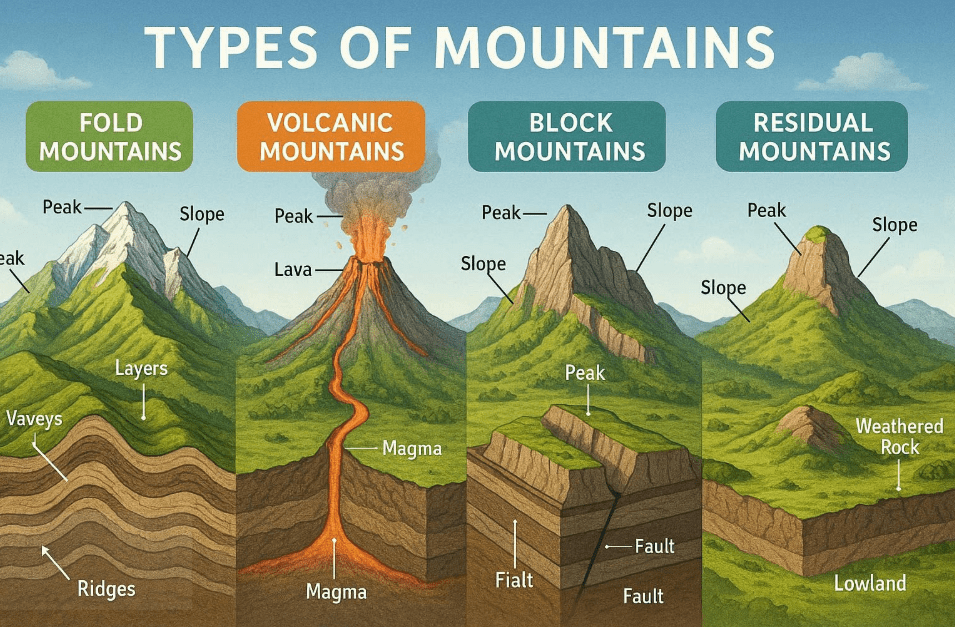
Mountains can be classified in several ways, but in geography, the most meaningful method is by how they are formed. This classification links mountain types directly to the geological processes shaping the Earth’s surface. By understanding the formation process, it becomes easier to explain why some mountains appear as long folded ranges, others as isolated volcanic cones, and some as heavily eroded remnants of ancient landscapes. The major types of mountains and how they form are discussed below.
Fold Mountains
Fold mountains are the most extensive and highest mountain ranges on Earth. They are formed mainly by compression at convergent plate boundaries, where two tectonic plates move toward each other. The intense pressure causes layers of sedimentary rock to bend, fold, and uplift rather than break, creating large mountain chains with complex structures.
Fold mountains are typically long, continuous ranges with high peaks and deep valleys. Classic examples include the Himalayas, formed by the collision of the Indian and Eurasian plates, and the Alps in Europe. These mountains are often geologically young and continue to rise due to ongoing tectonic forces.
Volcanic Mountains
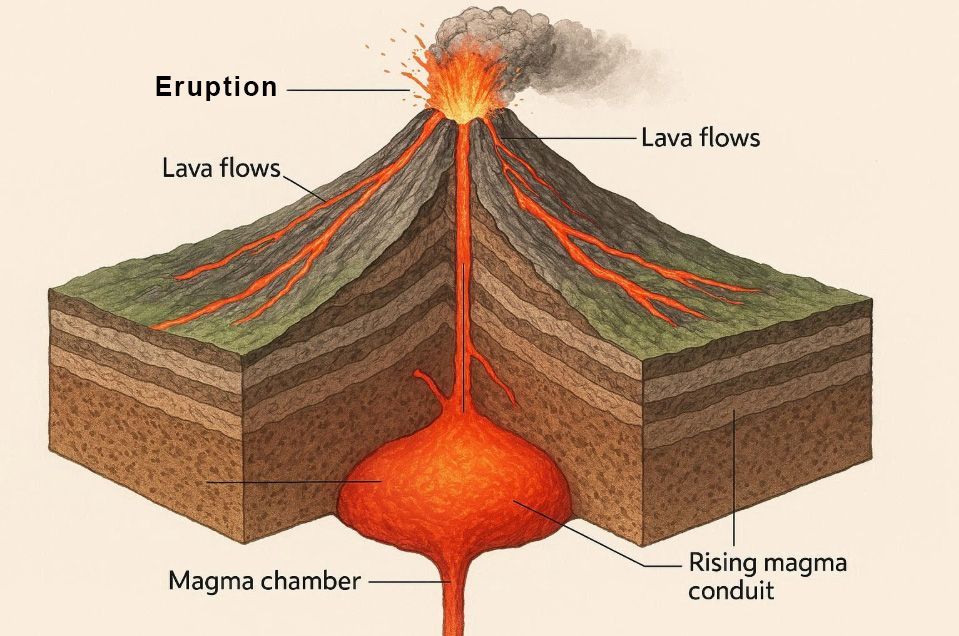
Volcanic mountains are built through volcanic activity when magma rises from deep within the Earth and erupts at the surface. Over time, repeated eruptions deposit layers of lava, ash, and other volcanic materials, gradually building up a mountain. The shape and size of volcanic mountains depend largely on the type of magma and eruption style.
Gentle, fluid lava flows tend to form broad, gently sloping mountains, while explosive eruptions create steep-sided cones. Well-known examples include Mount Fuji in Japan and Mount Kilimanjaro in Tanzania. These mountains clearly show the close relationship between volcanism, magma movement, and mountain formation.
Curious about how volcanic activity shapes the Earth and builds entire mountains from scratch? Explore our full guide on Volcanoes: Types, Formation, and How They Work to see how magma, eruptions, and volcanic processes create landscapes and ecosystems over time.
Block Mountains (Fault-Block Mountains)
Block mountains are formed by faulting and crustal tension rather than folding. When the Earth’s crust is stretched, large blocks of rock may break along faults and move vertically. Some blocks are uplifted to form block mountains, known as horsts, while adjacent blocks may sink to form valleys called grabens.
This process creates steep-sided mountains with flat or gently sloping tops. Block mountains are common in regions affected by tensional forces within the crust. A well-known example is the Sierra Nevada in the United States, which rose due to faulting along major fracture zones.
Residual (Erosional) Mountains
Residual mountains are the remains of much older mountain systems that have been extensively worn down by erosion over millions of years. Unlike fold or volcanic mountains, they are not actively formed by tectonic forces today. Instead, weathering and erosion gradually remove softer rock, leaving behind more resistant rock masses as isolated or low-relief mountains.
These mountains often appear rounded and less dramatic in height. Examples include the Scottish Highlands and the Jos Plateau in Nigeria. Residual mountains provide important evidence of Earth’s long geological history and the powerful role of erosion in shaping landscapes.
Mountain Formation and Earth’s Interior
Mountain formation is deeply connected to processes occurring within Earth’s interior. Heat from the mantle drives mantle convection, which moves tectonic plates at the surface and creates the forces responsible for uplift, folding, faulting, and volcanism. In many regions, magma generated in the mantle rises through the crust, contributing to volcanic mountains and weakening the crust to allow uplift.
These internal Earth dynamics explain why mountain belts often align with plate boundaries and zones of intense geological activity. By studying the link between mantle processes, magma movement, and crustal deformation, geographers and earth scientists gain a clearer understanding of how mountains are formed and why they continue to evolve over geological time.
Do you want to understand what’s happening beneath your feet as mountains rise? Check out our post on Inside the Earth: Crust, Mantle, and Core to discover how the Earth’s layers, tectonic forces, and mantle convection drive the formation of mountains and shape our planet’s surface.
Mountains and Climate
Mountains play a major role in shaping climate patterns at both regional and global scales. One of the most important ways mountains influence climate is through orographic rainfall. When moist air masses move toward a mountain range, they are forced to rise along the slopes. As the air rises, it cools and condenses, leading to increased precipitation on the windward side of the mountain. This process explains why many mountainous regions experience heavy rainfall and support dense vegetation and major river systems.
On the opposite side of the mountain, a rain shadow effect often develops. After the air has lost much of its moisture on the windward slope, it descends on the leeward side as dry, warmer air. This results in significantly lower rainfall and drier conditions, sometimes creating deserts or semi-arid landscapes.
Well-known examples include the dry regions east of the Andes and the rain shadow areas behind the Himalayas. This contrast shows how mountains can create sharp climatic differences over relatively short distances.
Beyond local effects, mountains also influence regional and global climate systems. Large mountain ranges act as barriers that redirect wind patterns and affect the movement of air masses. High-altitude regions are typically cooler, which impacts temperature distribution and seasonal climate variations.
Mountains also store snow and ice, contributing to Earth’s water cycle and affecting sea levels and long-term climate trends. Through these combined processes, mountains are not just landforms but powerful climate regulators that shape environments far beyond their immediate surroundings.
Mountains and Human Life
Mountains play a vital role in shaping human life and natural systems across the world. One of their most important contributions is as major sources of freshwater. Many of the world’s largest rivers originate in mountain regions, fed by rainfall, snow, and glaciers that store water and release it gradually throughout the year.
These rivers support agriculture, provide drinking water, and sustain ecosystems far beyond the mountain slopes. In this way, mountains act as natural water towers that are essential for human survival.
Mountains also influence human settlement and culture. Their steep terrain and rugged landscapes often act as natural barriers, limiting movement and interaction between regions. This isolation has helped preserve unique cultures, languages, and traditions in many mountainous areas. At the same time, mountain environments can be difficult to inhabit due to harsh climates, steep slopes, and limited arable land, which affects population distribution and economic activities.
Despite their importance, mountains are also associated with significant natural hazards. Landslides, avalanches, earthquakes, and volcanic eruptions are common in many mountainous regions because of active tectonic processes and unstable slopes. These hazards can threaten lives, infrastructure, and livelihoods, especially where communities live close to steep terrain or active geological zones. Understanding the geological processes that form mountains is therefore crucial for reducing risk and improving disaster preparedness.
Mountains are also rich in natural resources that support human economies. Many valuable minerals and metals are found in mountain regions due to past geological activity. Mountain soils, especially those influenced by volcanic materials, can be fertile and suitable for agriculture.
In addition, mountains attract millions of tourists each year for recreation, adventure, and scenic beauty, making tourism an important source of income for many countries. Overall, mountains strongly influence water supply, culture, hazards, and resources, highlighting their central role in human geography and environmental systems.
Mountains, Biodiversity, and Biogeography
Mountains are much more than towering landforms; they act as natural habitat islands, creating unique ecological niches that support a wide variety of species. The steep gradients and varied climates along mountain slopes result in altitudinal zonation, where different vegetation types and animal communities occupy distinct elevation bands.
For example, lower slopes may support dense forests, mid-elevations host temperate woodlands, and high peaks are dominated by alpine tundra or sparse vegetation. This vertical separation encourages endemism, meaning many species found on mountains exist nowhere else on Earth.
Over time, plants and animals adapt to the specific conditions of each zone, evolving specialized traits to survive in challenging environments. Mountains, therefore, play a critical role in biogeography, shaping species distribution and promoting biodiversity hotspots. Their isolation and range of microclimates make them living laboratories for studying how geography and ecological processes interact.
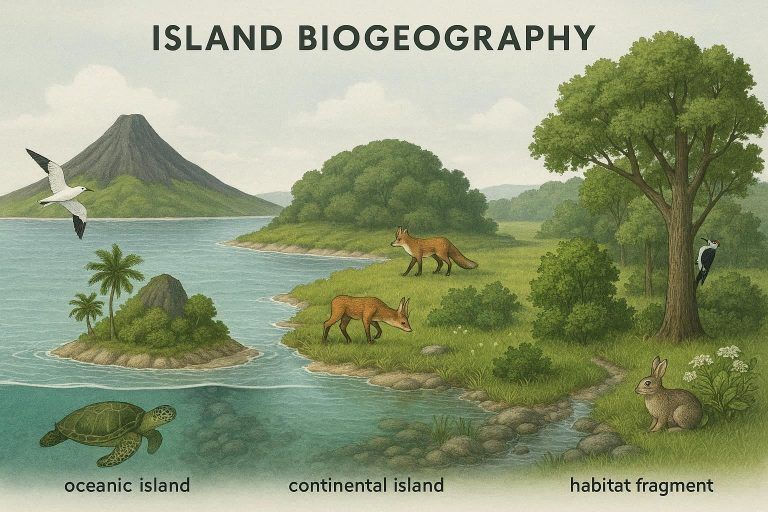
Mountains can be as isolated as islands, creating unique ecosystems teeming with specialized species. Learn more about these fascinating patterns in our Island Biogeography post, and see how geography shapes life in isolated habitats.
Why Mountains Matter to Geography Students
Mountains are more than just striking landscapes; they are essential features for geography students to study because they integrate multiple aspects of physical and human geography. Understanding mountains is highly relevant for exams, as questions often cover their formation, types, and the processes shaping them.
Mountains also provide excellent opportunities for fieldwork, allowing students to observe geological structures, erosion patterns, and vegetation zones firsthand. Studying mountains helps link physical geography, such as tectonic activity, climate patterns, and soil formation, with human geography, including settlement patterns, resource use, and hazard management.
Moreover, mountains encourage systems thinking, as students analyze how interrelated processes like erosion, volcanic activity, climate, and human interventions interact to shape complex landscapes. By learning about mountains, geography students gain practical skills, analytical abilities, and a deeper understanding of the dynamic forces shaping our planet.
In conclusion, mountains are some of the most striking features on Earth, formed through a variety of geological processes that shape our planet’s surface over millions of years. From fold mountains created by the collision and compression of tectonic plates, to volcanic mountains built from lava and eruptions, block mountains formed by faulting, and residual mountains shaped by long-term erosion, each type tells a story about Earth’s dynamic crust. Understanding how mountains are formed not only deepens our knowledge of geology and geomorphology but also highlights the importance of tectonic activity, volcanism, and erosion in creating the diverse landscapes we see today.
Ready to test your understanding? Take our Mountains Quiz to challenge your knowledge of mountain types, formation processes, and the geological forces that shape these majestic landforms.
References and Further Reading
-
How Are Mountains Formed? — Encyclopaedia Britannica
Detailed overview of mountain formation processes, including folding, faulting, and volcanism
https://www.britannica.com/science/How-Are-Mountains-Formed Encyclopedia Britannica -
Fold Mountain — National Geographic Education
Explanation of fold mountains and tectonic plate collision
https://education.nationalgeographic.org/resource/fold-mountain/ National Geographic Education -
Mountain Formation and Types — Physical Geology (LibreTexts)
Academic description of orogenic processes and mountain building
https://geo.libretexts.org/Courses/Chabot_College/Introduction_to_Physical_Geology_(Shulman)/11%3A_Geological_Structures_and_Mountain_Building/11.04%3A_Mountain_Building Geosciences LibreTexts -
Mountain Formation and Types — Lumen Learning
Educational resource explaining tectonic forces, faults, and volcanic contributions to mountain formation
https://courses.lumenlearning.com/suny-earthscience/chapter/mountain-formation/ Lumen Learning -
Types of Mountains — Ultimate Kilimanjaro (Educational Travel Guide)
Accessible, well‑organized explanation of fold, fault‑block, and volcanic mountains plus examples
https://www.ultimatekilimanjaro.com/how-are-mountains-formed/ Ultimate Kilimanjaro -
Types of Mountains — Study.com
Clear breakdown of upwarped, volcanic, folded, and fault‑block mountains for learning and revision
https://study.com/learn/lesson/mountain-types-examples.html study.com -
Classification of Mountains by Origin — Prepp.in Geography Notes
Geography explanation of mountain types based on origin (fold, fault‑block, volcanic)
https://prepp.in/news/e-492-classification-of-mountains-on-the-basis-of-origin-geography-notes Prepp

Idara Eniang is a passionate digital creator and geographer dedicated to making geography simple, visual, and accessible.