Inside the Earth: A Simple Guide to Earth’s Crust, Mantle, and Core

Have you ever wondered what lies beneath your feet, beyond the soil, beyond the rocks, and deep into the unseen world below the Earth’s surface? Our planet may look calm from the outside, but beneath the crust is a vast system of molten rock, shifting plates, extreme temperatures, and powerful forces that shape everything we see. From earthquakes and volcanoes to mountain building and ocean formation, the hidden layers of the Earth control the landscapes and environments we depend on every day.
Understanding the crust, mantle, and core isn’t just basic geography; it’s the key to unlocking some of Earth’s greatest mysteries. This simple internal structure influences natural disasters, mineral resources, climate patterns, and even the future of life on our planet. In this guide, you’ll explore how each layer works, why they matter, and how they interact in ways more dramatic than you ever imagined.
Overview: Understanding the Earth’s Layers
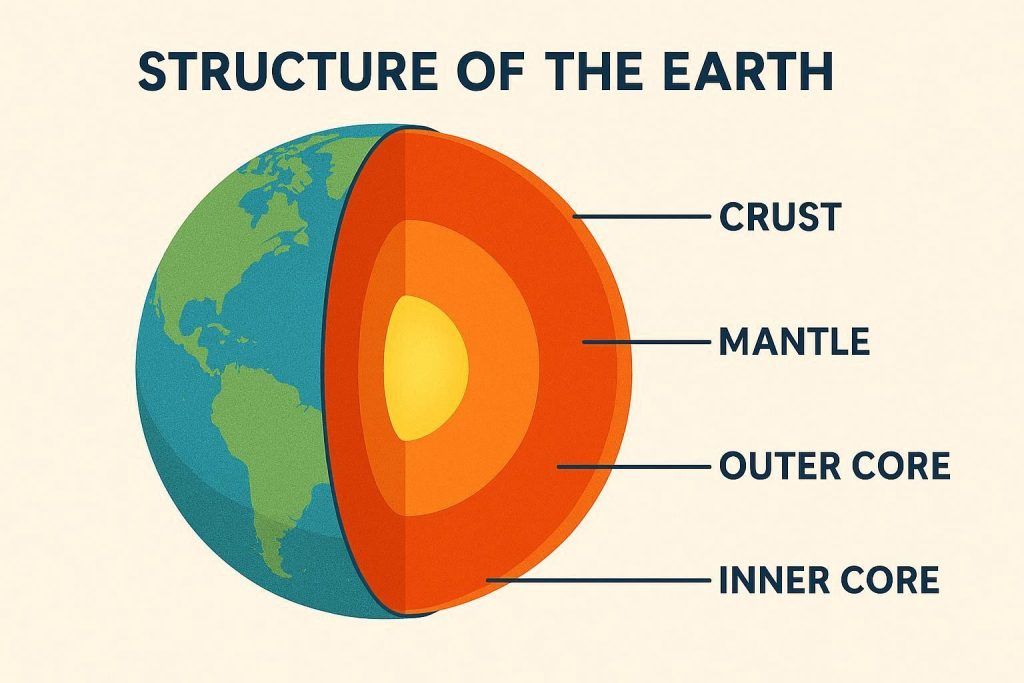
The Earth may look like a simple round ball from space, but beneath our feet lies a complex world made of layers that shape everything we see on the surface. From mountains and volcanoes to earthquakes and ocean floors, the structure of the Earth plays a major role in how our planet behaves. Scientists divide the Earth into three main layers: the crust, mantle, and core, each with its own unique materials, temperatures, and movements.
These layers work together like parts of a giant machine, constantly shifting and interacting in ways that have shaped our continents for millions of years. Understanding how these layers function is the foundation of physical geography and geology. It helps us answer important questions like why earthquakes happen, how volcanoes form, and what makes the Earth different from other planets.
What Exactly Lies Beneath Earth’s Surface?
Understanding what lies beneath our feet is one of the most fascinating parts of physical geography and Earth science. Although the Earth looks solid and stable from the surface, its interior is made up of different layers that vary in temperature, density, and composition. These layers;
- The crust
- The mantle
- and core
were discovered through scientific methods such as seismic wave studies, volcanic evidence, rock density measurements, and deep-Earth modelling. Each layer plays a unique role in shaping the planet: the crust forms the land and oceans we live on, the mantle drives plate tectonics through slow, powerful movements, and the core generates
Earth’s magnetic field protects life from harmful solar radiation. By exploring these layers step by step, you will gain a clearer understanding of how Earth works from the inside out, and why its internal structure matters for climate, landscapes, and life itself.
The Earth’s Crust: Our Planet’s Outer Skin
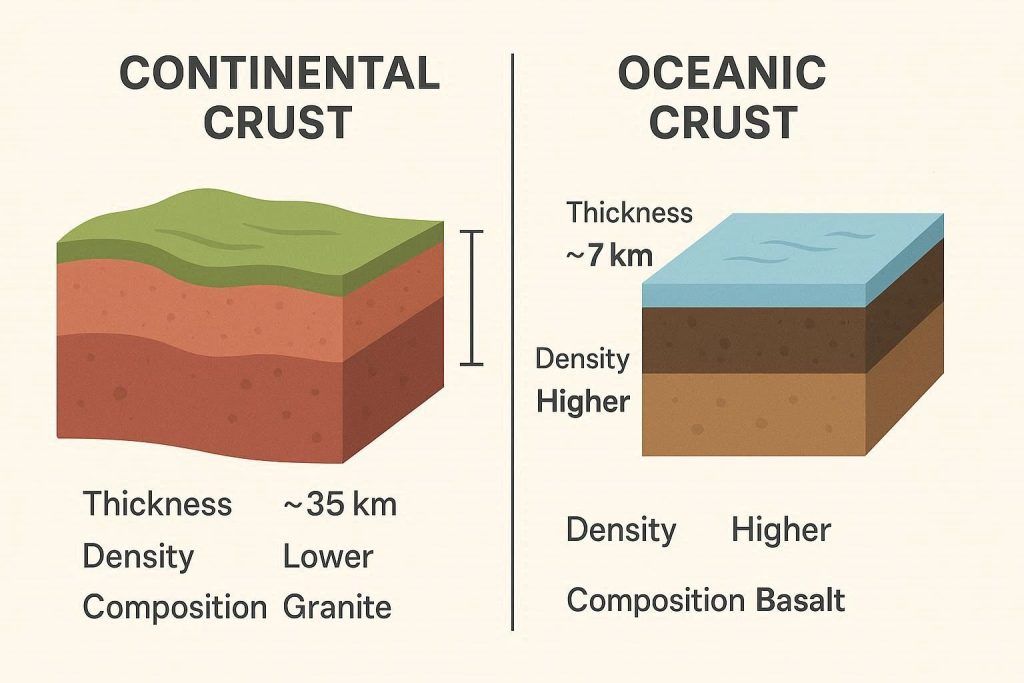
The Earth’s crust is the thin, solid outer layer where all life exists, yet it represents less than 1% of the planet’s total mass. Scientists often describe it as Earth’s “skin” because of how fragile and shallow it is compared to the deeper layers below. The crust is divided into large slabs called tectonic plates, which float on the semi-molten mantle. These plates slowly move, collide, and shift, creating earthquakes, mountains, volcanoes, and ocean trenches. The crust itself comes in two main types:
- The Continental crust: Which is thick and light, and
- The Oceanic crust: which is thinner but denser.
Understanding this layer helps us make sense of many natural processes, from the formation of landscapes to the occurrence of natural disasters.
The Mantle: Solid Rock in Motion
Mantle composition, depth, and the asthenosphere vs the lithosphere
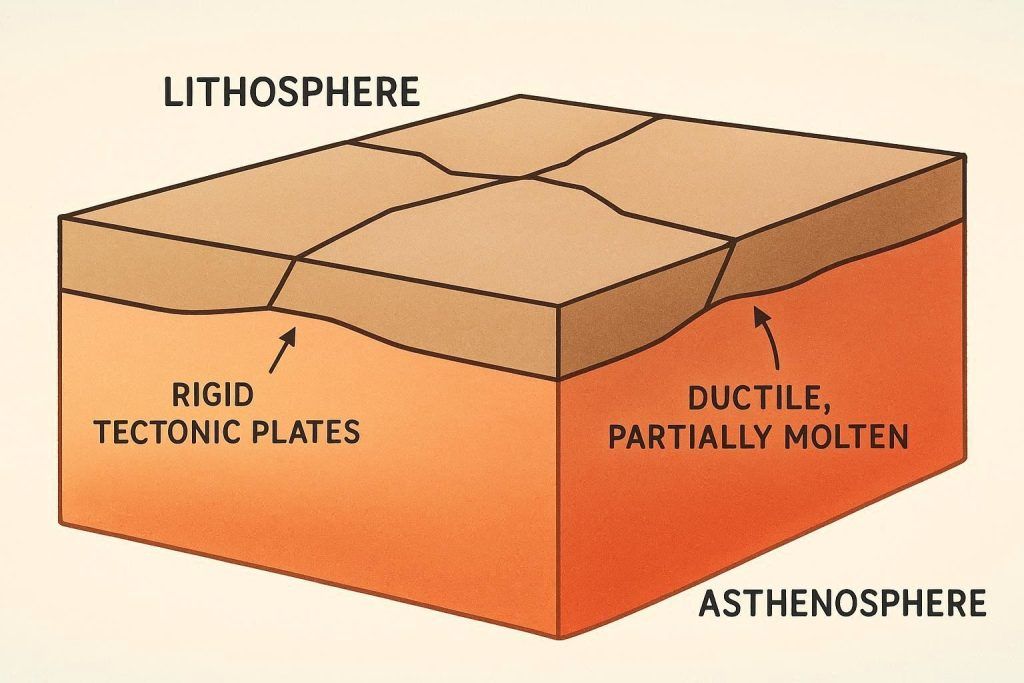
Beneath the Earth’s crust lies the mantle, a thick layer of hot, dense, silicate rock that extends from about 30 km to 2,900 km below the surface. Although it is solid, the mantle’s high temperature and pressure conditions allow it to deform slowly over long periods of time. The uppermost part of the mantle combines with the crust to form the lithosphere, a rigid, brittle shell broken into tectonic plates.
Just below it lies the asthenosphere, a partially molten, softer layer where rock behaves plastically. This contrast between a strong lithosphere and a ductile asthenosphere is essential because it allows the tectonic plates to glide and shift across the Earth’s surface.
Mantle convection: the driver of plate tectonics
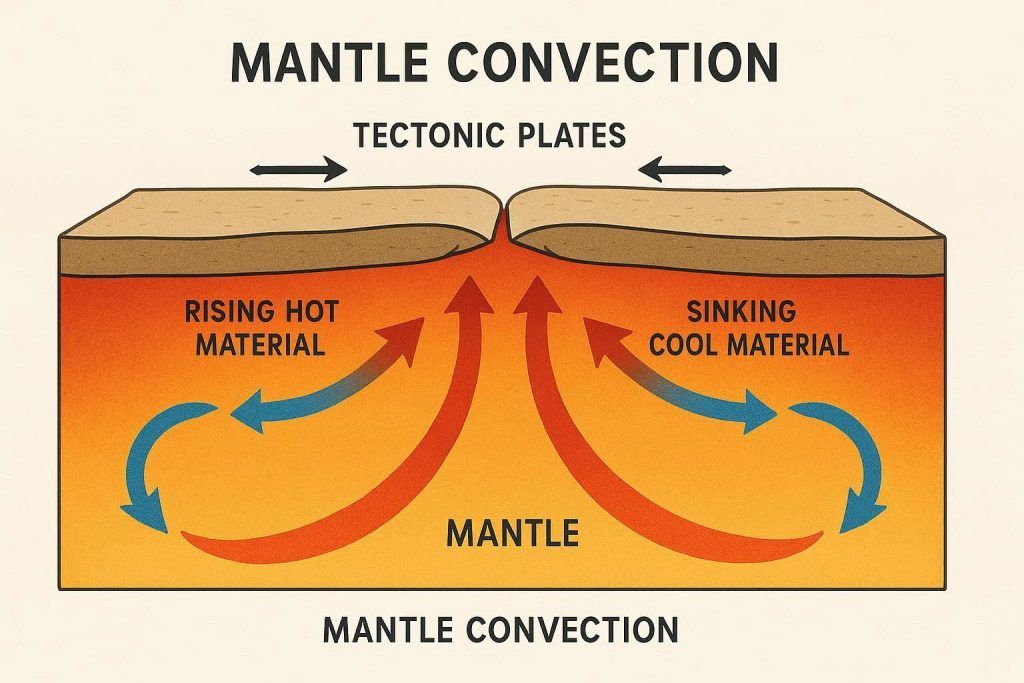
Deep inside the mantle, heat rising from the core creates slow, circulating currents known as mantle convection. Hot mantle material moves upward, cools as it nears the surface, and then sinks again, forming a continuous cycle. These convection currents act like a conveyor belt beneath the lithosphere, pushing and pulling tectonic plates in different directions.
This simple process is the engine behind many of Earth’s dynamic features: continental drift, seafloor spreading, mountain building, and even earthquakes.
Mantle sources for magmas, hotspots, and mantle plumes
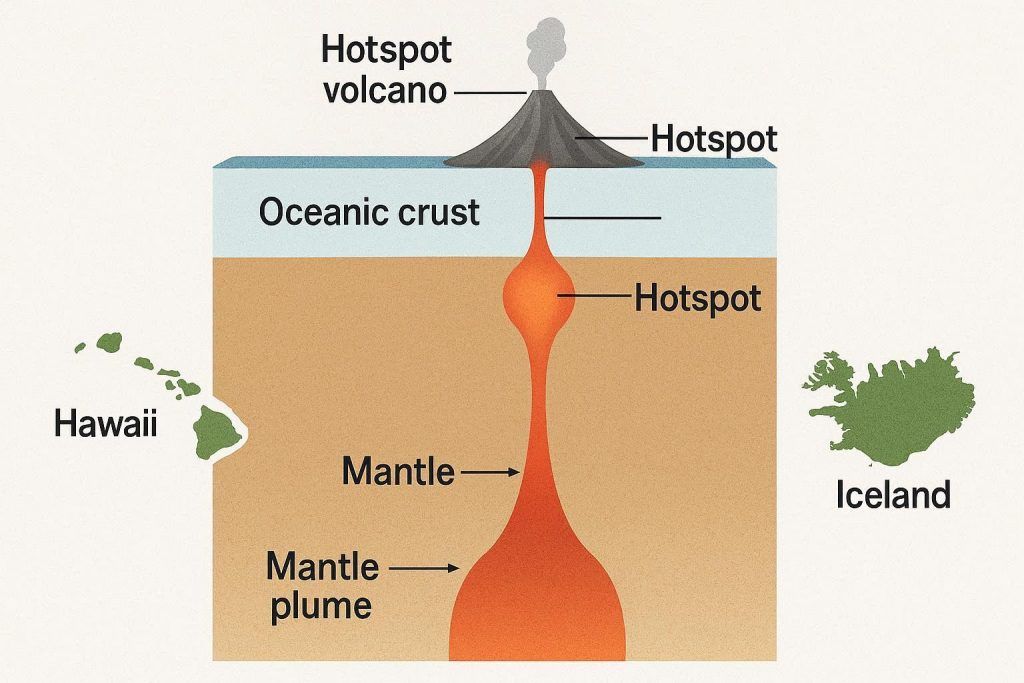
The mantle is also where most of Earth’s magma originates. In some regions, extremely hot material rises in narrow, focused columns called mantle plumes. When these plumes reach the base of the lithosphere, they partially melt the rock and create hotspot volcanoes.
Classic examples include Hawaii, where a deep plume has produced a long chain of volcanic islands as the Pacific Plate moves over it, and Iceland, where a hotspot beneath the Mid-Atlantic Ridge creates extraordinary volcanic activity. These hotspots are largely stationary, leaving behind volcanic tracks that help scientists trace plate movement over millions of years.
The Core: Iron Heart of the Earth
Outer core, inner core, composition, and temperature
At the very center of our planet lies the core, often described as the iron heart of the Earth. It is divided into two parts: the outer core, which is a hot, swirling sea of liquid iron and nickel, and the inner core, a solid sphere made mainly of iron. The outer core ranges from about 2,900 km to 5,150 km deep, with temperatures reaching 4,000–6,000°C, hot enough to keep metals in a molten state.
Below it, the inner core endures extreme pressure—so intense that it forces the iron to remain solid even at temperatures comparable to the surface of the Sun. This combination of liquid metal above and solid metal below is what makes Earth’s core one of the most fascinating layers of the planet.
How the core creates Earth’s magnetic field (geodynamo)
The movement of liquid iron in the outer core generates Earth’s powerful magnetic field, a process known as the geodynamo. As the molten metal circulates due to heat loss from the inner core, it creates electric currents that produce magnetic energy. This magnetic field extends far into space, forming the magnetosphere, which protects Earth from harmful solar radiation and solar wind.
Without the geodynamo, life on Earth would be far more vulnerable. In simple terms, the outer core acts like a giant natural generator, constantly powering the magnetic shield that surrounds our planet.
Why studying the core matters (seismic waves & Earth’s thermal history)
Even though no one can physically drill to the core, scientists study it using seismic waves produced by earthquakes. These waves travel through Earth’s interior and change speed depending on the materials they pass through, allowing researchers to map the solid and liquid layers of the core.
Understanding the core also helps scientists trace Earth’s thermal history—how heat escapes from the interior and drives processes such as mantle convection and plate tectonics. By studying the core, we learn more about the planet’s past, present, and future, including how long the magnetic field will last and how Earth continues to evolve internally.
How We Know: The Tools That Reveal Earth’s Crust, Mantle and Core
Before modern technology, scientists could only guess what lay beneath Earth’s surface. Today, geologists use a combination of the following methods and techniques to create a detailed picture of the planet’s internal layers. These tools allow us to “see” deep into the Earth without ever drilling to the mantle or core. They are;
1. Seismology and seismic wave types (P-waves and S-waves)
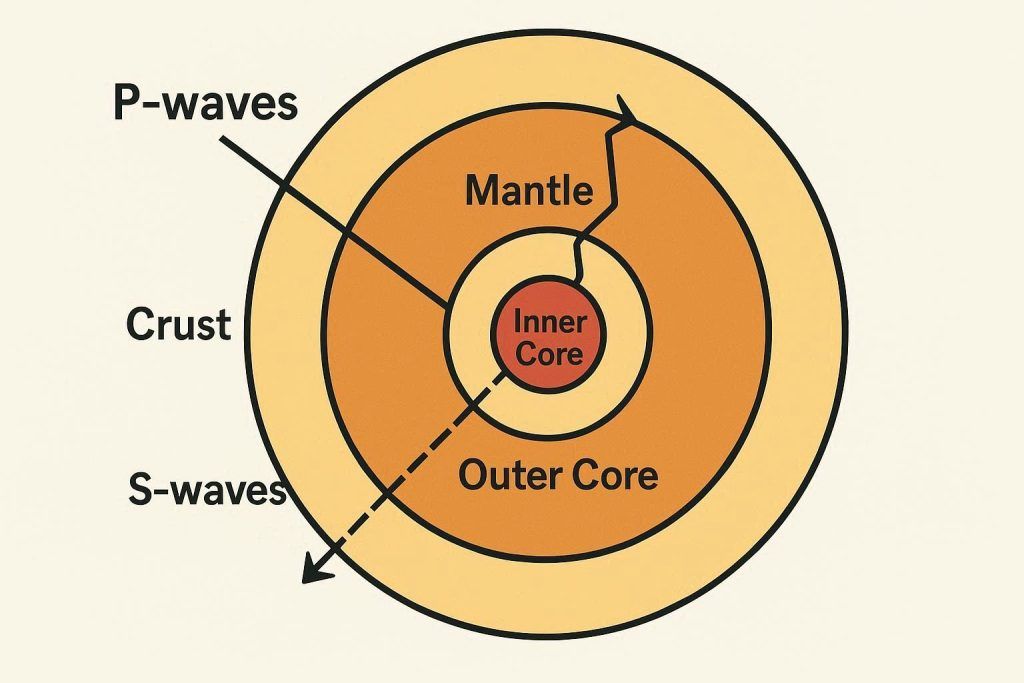
The most important window into Earth’s interior is seismology, the study of how energy waves travel through the planet during earthquakes. The two main types of seismic waves, P-waves (primary waves) and S-waves (secondary waves), behave differently as they move through solids and liquids.
P-waves can travel through both, but S-waves only move through solids. When scientists observed that S-waves disappear in certain regions, they realized the outer core must be liquid. By measuring how fast these waves travel and where they bend or reflect, geologists can map the crust, mantle, outer core, and inner core with remarkable accuracy.
2. Lab experiments, high-pressure physics, and meteorite evidence
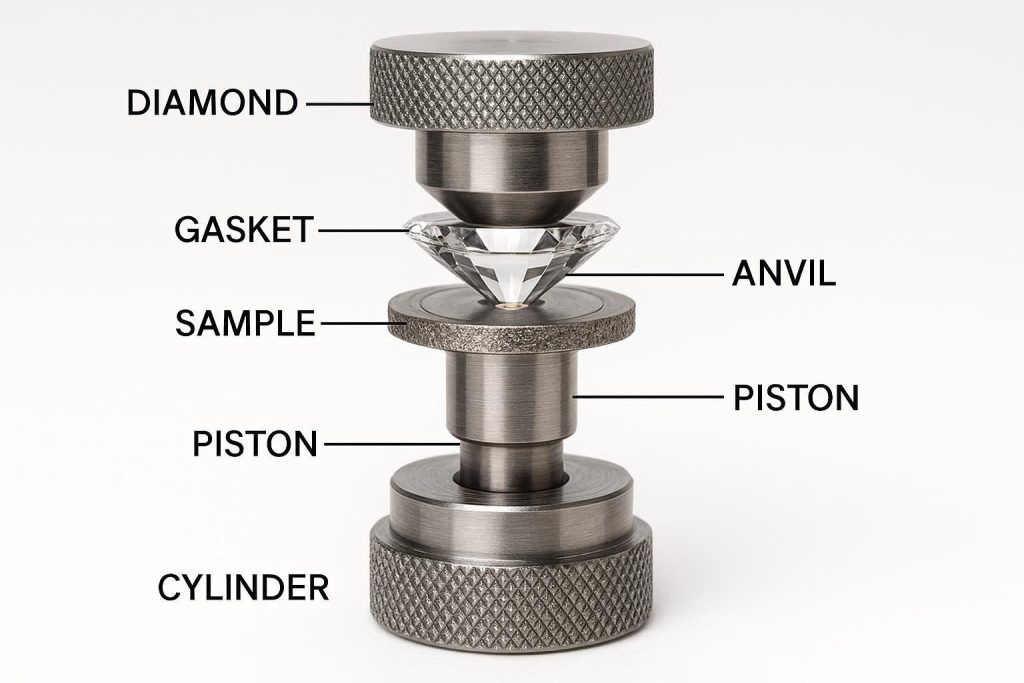
To understand what Earth’s interior is made of, scientists recreate extreme conditions in the lab using devices like diamond anvil cells, which squeeze materials to pressures found thousands of kilometres underground. These high-pressure experiments reveal how minerals behave inside the mantle and core.
Meteorites also offer valuable clues; they are fragments of early solar-system material that resemble the building blocks of Earth. By studying their composition, especially iron-nickel meteorites, researchers infer what the core is likely made of.
3. Geophysical imaging (tomography) and recent discoveries
Another powerful tool is geophysical tomography, which works like a medical CT scan but for the entire planet. By analyzing thousands of seismic wave paths from earthquakes worldwide, scientists can create 3D images of Earth’s interior. These models reveal hot plumes rising from the deep mantle, cold subducting slabs sinking into the lower mantle, and even variations inside the core.
Recent studies show surprising features, such as ultra-low velocity zones near the core-mantle boundary, mysterious regions that may hold clues about the formation and evolution of Earth.
Processes Connecting Layers, From Deep Earth to Surface
Earth’s interior is not just a stack of layers—it is a dynamic system where deep processes influence everything we see on the surface. From drifting continents to rising mountains and sudden earthquakes, the forces that shape our planet begin far beneath our feet. Understanding how these layers interact helps explain why Earth is so geologically active compared to other planets.
Plate tectonics recap (crust & mantle convection)
Plate tectonics is the unifying theory that explains how Earth’s surface is constantly reshaped. The crust is broken into large plates that sit on top of the ductile asthenosphere, and their movement is driven by mantle convection, the slow circulation of heat deep inside the Earth.
Hot material rises, cooler material sinks, and this continuous motion acts like a conveyor belt beneath the plates. This process connects the crust and mantle, powering events such as seafloor spreading, continental drift, and the opening or closing of oceans.
Volcanism and mountain building (deep processes shaping landscapes)
Many of Earth’s most dramatic landforms, volcanoes, island chains, and towering mountain ranges are surface expressions of deep internal forces. When molten rock rises from the mantle, it produces volcanism, creating volcanic arcs, hotspots, and new crust at mid-ocean ridges.
In contrast, when tectonic plates collide, the immense pressure can fold, uplift, and thicken the crust, forming spectacular mountain belts like the Himalayas or the Andes. These features remind us that landscapes are not static; they are constantly shaped, rebuilt, and reshaped by the engine driving Earth from within.
Feel free to read more about volcanoes in our recent article: Understanding the Geological Processes Behind Volcano Formation and Activity
Earthquakes and their link to internal structure
Earthquakes occur when stress builds up along faults and plate boundaries, causing sudden releases of energy. Their behaviour is directly connected to Earth’s internal structure. For example, shallow earthquakes tend to occur within the brittle lithosphere, while deeper ones happen where cold, rigid plates sink into the mantle during subduction.
The distribution and depth of earthquakes help scientists map plate boundaries, understand mantle dynamics, and even pinpoint the transition between Earth’s layers. In short, earthquakes are surface reminders of the powerful forces at work inside the planet.
Human Relevance — Resources, Hazards & Research
Understanding Earth’s internal structure isn’t just about science; it directly affects human life, global economies, and future research. From the resources we depend on to the hazards we try to predict, the planet’s inner workings play a major role in shaping societies. Knowing how the Earth functions helps us manage its resources wisely and reduce the risks associated with natural disasters.
Natural resources tied to Earth’s structure (minerals & geothermal energy)
Many of the natural resources humans rely on, such as minerals, metals, and geothermal energy, are products of Earth’s internal processes. Valuable minerals like gold, copper, and diamonds form deep within the crust and mantle under intense heat and pressure.
Tectonic activity helps bring these resources closer to the surface, where they can be mined. In addition, geothermal energy comes from the heat stored inside the Earth, especially in volcanically active regions. This clean, renewable energy source is directly linked to the movement of magma and the planet’s internal heat engine.
Hazards: earthquakes, volcanic eruptions, and risk reduction
Natural hazards such as earthquakes, volcanic eruptions, and tsunamis are all rooted in Earth’s internal structure and tectonic activity. By studying plate boundaries, mantle convection, and fault systems, scientists can identify high-risk areas and develop early warning systems.
Understanding how and why these hazards occur allows communities to build safer structures, prepare emergency plans, and reduce loss of life. In this way, knowledge of Earth’s interior becomes a powerful tool for disaster risk reduction.
Modern research frontiers and why students should care
Today’s geoscientists are exploring exciting frontiers, such as comparing Earth’s interior to those of Mars, the Moon, and other planets, studying how deep Earth processes influence long-term climate patterns, and using advanced imaging techniques to create detailed 3D models of the mantle and core.
These discoveries help scientists answer big questions about Earth’s evolution, plate tectonics, and the future of our planet. For students, understanding Earth’s interior opens the door to careers in geology, environmental science, energy research, hazard management, and even planetary exploration.
Conclusion
Earth’s interior may be hidden from view, but its influence is everywhere, from drifting continents and towering mountains to the minerals we use daily and the hazards we prepare for. By understanding the crust, mantle, and core, we gain a clearer picture of how our planet works as a connected system.
The movement of tectonic plates, the rise of magma, the generation of the magnetic field, and the distribution of earthquakes all trace back to the deep processes beneath our feet. Simply put: the story of Earth’s surface begins inside the Earth itself.
If you enjoyed learning about Earth’s Crust, Mantle and Core, there’s more to explore! Check out my related posts on Plate Tectonics, The Rock Cycle, and Seismic Hazards to deepen your understanding of how the planet changes over time. And don’t forget to test what you’ve learned by taking the Earth Structure Quiz a fun way to see how much you truly know about our dynamic planet.
External Sources for further studies
-
Britannica – Earth’s Interior: Crust, Mantle, Core – Authoritative overview of Earth’s internal composition and layers. Earth – Core, Mantle, Crust | Britannica
-
USGS – Inside the Earth – U.S. Geological Survey explanation of the three main shells, thicknesses, and composition. Inside the Earth | USGS
-
National Geographic – Earth’s Interior – Student-friendly summary of crust, mantle, core layers and how they behave. Earth’s Interior | National Geographic
-
Britannica – Earth’s Layers & Seismic Evidence – Explains how crust, mantle, and core were determined using seismic waves. Plate tectonics – Earth’s Layers (Britannica)
-
National Geographic Education – Crust, Mantle, Core Facts – Another clear, concise reference on layer thickness, composition, and role. Earth’s Internal Structure | National Geographic Education
-
USGS – Earth’s Interior Elementary Description – U.S. Geological Survey historical and geophysical explanation of interior layering. The Interior of the Earth (USGS)
-
USGS – Earth’s Interior Seismic & Density Data – Explains seismic wave behaviour and how scientists map Earth’s interior. Earth’s Interior Seismic Evidence (USGS)

Idara Eniang is a passionate digital creator and geographer dedicated to making geography simple, visual, and accessible.