Introduction
Island biogeography explains how plants and animals reach isolated lands, survive in limited spaces, and gradually evolve into unique forms of life. It focuses on islands not just as places surrounded by water, but as natural experiments where the movement, adaptation, and loss of species can be clearly observed.
Because islands are separated from larger ecosystems, even small changes in climate, distance, or size can strongly influence which species succeed and which disappear.
Many islands are born through dramatic geological processes, especially volcanic eruptions that create entirely new land for life to colonize. This makes island biogeography closely connected to both volcanic activity and the broader ideas introduced in biogeography as a whole.
In this article, you will explore the theory of island biogeography, the key factors that shape island biodiversity, real-world examples from across the globe, and why these concepts matter for conservation, human impact, and the future of Earth’s ecosystems.
What Is Island Biogeography?
Island biogeography can be defined as a branch of biogeography that explains how species are distributed across isolated environments and why some islands support more life than others. In this context, an island does not only mean land surrounded by water. It also includes habitat islands such as mountain tops, isolated lakes, forest fragments, and even protected green spaces within cities, all of which are separated from similar habitats by barriers that limit movement.
Unlike general biogeography, which studies species distribution across broad regions and continents, island biogeography focuses specifically on isolation and its effects on biodiversity. Isolation matters because it controls how easily plants and animals can reach an area, survive there, and reproduce. When movement is limited, immigration slows, extinction risks increase, and unique species are more likely to evolve, making island biogeography essential for understanding patterns of species distribution, endemism, and conservation planning.
If island biogeography is new to you, it helps to first understand the broader principles behind species distribution.
Read our 👉 Introduction to Biogeography to build a strong foundation before exploring how isolation shapes life on islands.
The Theory of Island Biogeography
To fully understand why some islands are rich in species while others support only a few, scientists developed a structured explanation known as the theory of island biogeography. This theory provides a clear framework for explaining how isolation, size, and movement of species interact to shape biodiversity over time. It remains one of the most important ideas linking ecology, geography, and conservation science.
Origins of the Theory
The theory of island biogeography was proposed in the 1960s by Robert MacArthur and Edward O. Wilson. It was developed to explain observable patterns in species distribution on islands, especially why larger islands tend to have more species than smaller ones and why islands closer to the mainland are more biologically diverse than distant ones.
The central idea is simple but powerful. The number of species on an island is controlled by a balance between new species arriving through immigration and existing species disappearing through extinction.
Core Concepts of the Theory
At the heart of island biogeography are a few key processes. The immigration rate refers to how frequently new species arrive on an island, which is influenced by distance from the mainland. The extinction rate depends largely on island size, since smaller islands support fewer resources and smaller populations.
These two forces interact to produce a species equilibrium, where the number of species remains relatively stable even though individual species may come and go. This highlights an important principle of the theory. Island ecosystems are dynamic systems, constantly changing rather than fixed or permanent, making island biogeography essential for understanding biodiversity patterns and conservation planning.
Key Factors Influencing Island Biodiversity
Not all islands support the same number of plant and animal species, even when they are formed in similar ways. Some islands are rich in biodiversity, while others host only a few hardy organisms. This difference is not random. Island biogeography identifies key factors that control how many species an island can support and how stable those populations remain over time. Among the most important are island size and distance from the mainland.
Island Size (Area Effect)
Island size plays a major role in determining biodiversity. Larger islands usually contain a wider variety of habitats, which allows more species to find suitable living conditions. They can support larger populations, reducing the risk of extinction caused by environmental change or random events. In contrast, smaller islands have limited space and resources, making species more vulnerable to extinction. This pattern is described by the species area relationship, which shows that the number of species increases as island size increases.
Distance from the Mainland (Isolation Effect)
Distance from the mainland also strongly influences island biodiversity. Islands located close to the mainland are easier for species to reach, leading to higher immigration rates and greater species diversity. Distant islands are harder to colonize, as plants and animals must overcome significant dispersal challenges.
Wind can carry seeds, water currents can transport organisms, and animals can act as carriers, but these processes become less effective over long distances. As a result, highly isolated islands often have fewer species but a greater chance of developing unique forms of life.
Island Formation and Volcanism
Many of the world’s most fascinating islands owe their existence to volcanic activity. When volcanoes erupt beneath the ocean or along tectonic boundaries, molten lava gradually builds up until it breaks the surface, creating entirely new land.
This process directly connects island biogeography with the geological processes behind volcano formation and activity, a topic explored in detail in our volcanoes article. These newly formed islands provide a rare opportunity to observe how life begins, spreads, and evolves from scratch.
Volcanic Islands
Volcanic islands form when repeated eruptions deposit layers of lava that cool and harden over time. Famous examples include Hawaii, Iceland, and the Galápagos Islands, all shaped by ongoing volcanic processes. At the moment of formation, these islands are lifeless, consisting only of bare rock. Over time, plants and animals arrive through wind, water, and animal movement. As more species successfully colonize the island, biodiversity slowly increases, making volcanic islands key examples in island biogeography.
To fully understand how volcanic islands like Hawaii, Iceland, and the Galápagos are formed, and the geological processes that create them. Read our article on 👉 Introduction to Volcanoes: Types, Formation, and How They Work to see how volcanic activity builds new land from deep within the Earth.
Ecological Succession on New Islands
Once a volcanic island forms, ecological succession begins. Pioneer species such as lichens, mosses, and hardy plants are usually the first to colonize the rocky surface. These organisms help break down rock and contribute organic matter, leading to soil formation. As soil develops, larger plants, insects, birds, and eventually complex ecosystems can establish.
This gradual development shows how isolation, time, and environmental conditions shape ecosystems, making new volcanic islands natural laboratories for studying island biodiversity.
Types of Islands in Biogeography
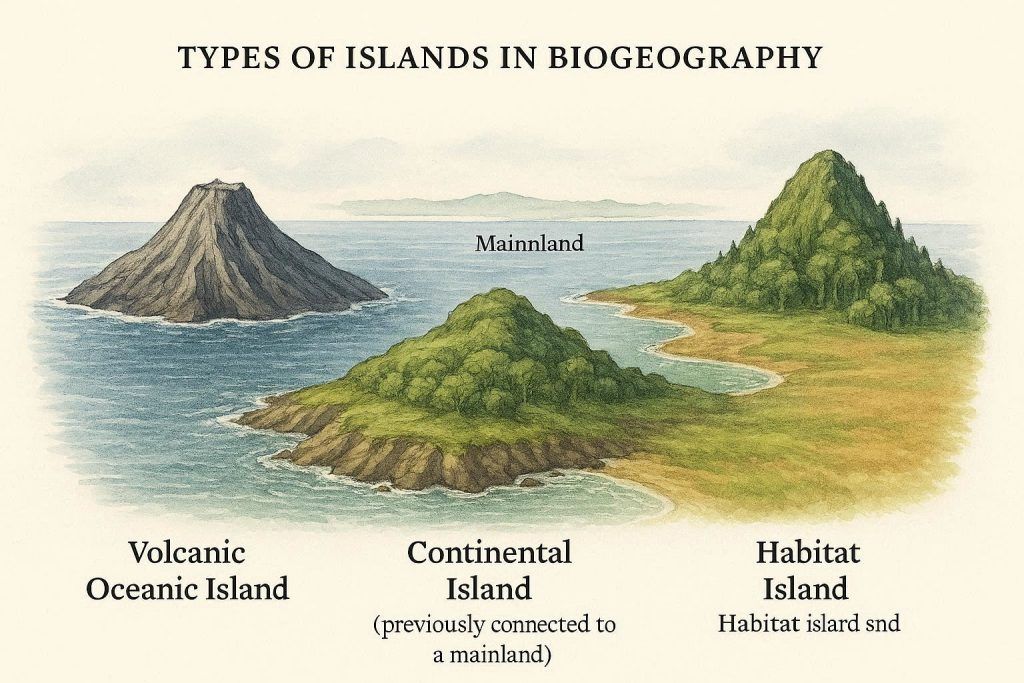
Not all islands are the same, and understanding their differences is essential to grasping island biogeography. In biogeography, islands are classified based on their origin, history, and degree of isolation. These differences strongly influence how species arrive, survive, and evolve. The following are the three main types of islands studied in biogeography:
- Oceanic Islands
Oceanic islands are formed independently in the ocean and have never been connected to any continent. Most of them originate from volcanic activity, rising from the seafloor through repeated eruptions. Because plants and animals must cross vast distances of water to reach these islands, species diversity is often low at first. However, isolation encourages high endemism, meaning many species evolve there and exist nowhere else in the world.
- Continental Islands
Continental islands were once part of a mainland but became separated due to processes such as sea level rise, tectonic movement, or erosion. Since they were previously connected to continents, these islands tend to have species that are more similar to those on the nearby mainland. Examples include islands located along continental shelves. Although isolation still affects species distribution, extinction rates are often lower compared to oceanic islands.
- Habitat Island
Habitat islands are areas of suitable habitat surrounded by environments that are unsuitable for certain species. These include forest fragments in agricultural areas, mountain peaks surrounded by lowlands, isolated lakes, and urban green spaces within cities. Even though they are not surrounded by water, habitat islands function like true islands because movement between them is restricted. This makes habitat islands especially important in conservation studies and urban ecology, where isolation can strongly influence biodiversity patterns.
Endemism and Adaptive Radiation
One of the most fascinating outcomes of island biogeography is the development of unique life forms found nowhere else on Earth. Isolation, limited resources, and reduced competition create conditions that strongly influence how species evolve over time. Two key concepts that explain these patterns are endemism and adaptive radiation.
What Is Endemism?
Endemism refers to species that are native to a specific location and are not naturally found anywhere else in the world. Islands are especially known for high levels of endemism because their isolation limits gene flow from mainland populations. When species arrive on an island, they adapt to local conditions over many generations, often evolving into distinct forms. Over time, this isolation leads to the development of plants and animals that are uniquely suited to their island environments.
Adaptive Radiation
Adaptive radiation occurs when a single ancestral species rapidly evolves into multiple new species, each adapted to a different ecological niche. This process is common on islands where new habitats and resources are available, and competition is initially low. Classic examples include finches that evolved different beak shapes to exploit various food sources, reptiles that adapted to diverse island environments, and plant species that diversified to occupy different ecological roles. Adaptive radiation highlights how isolation drives biodiversity and makes islands hotspots of evolutionary change.
Island Biogeography and Human Impact
After understanding the different types of islands in biogeography, it becomes clear that human activities can create island-like conditions even where no natural islands exist. Through land use changes, urban expansion, and global movement of species, humans have become powerful agents shaping island biogeography. These impacts often increase isolation, disrupt natural balances, and place unique ecosystems under pressure.
Habitat Fragmentation
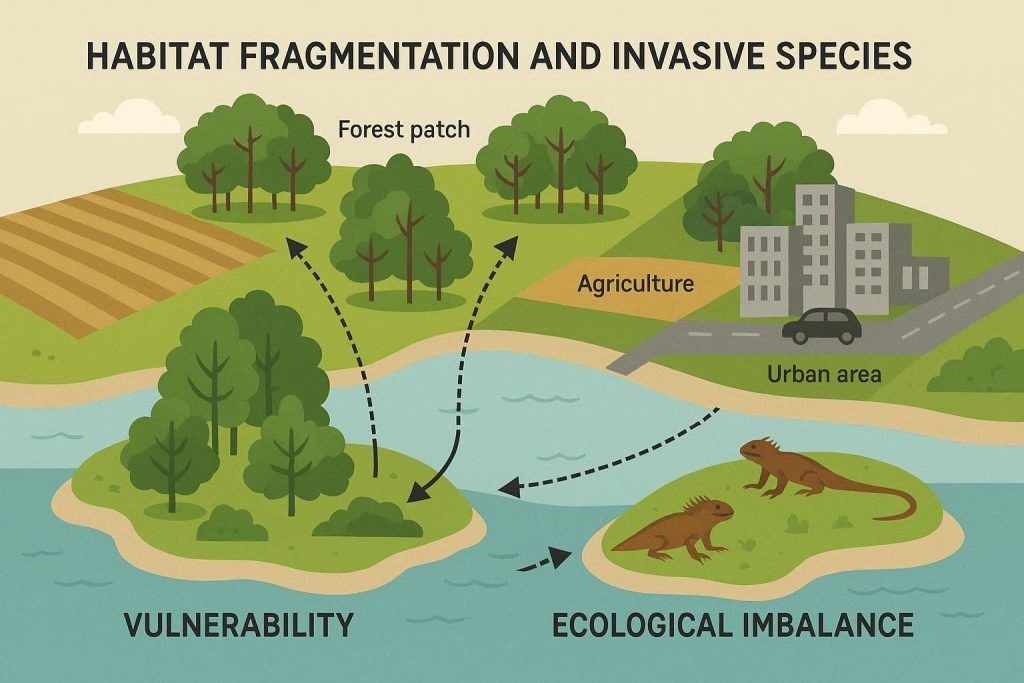
Habitat fragmentation occurs when large, continuous ecosystems are broken into smaller, isolated patches due to agriculture, road construction, or urban development. These fragmented areas function like forest islands surrounded by farmland or cities, limiting the movement of species between them. Just like true islands in the ocean, fragmented habitats experience reduced immigration and higher extinction risks, making them a key concern in modern island biogeography and conservation planning.
Invasive Species
Islands are especially vulnerable to invasive species because native organisms often evolve without strong competitors or predators. When humans introduce new plants or animals intentionally or accidentally, these invasive species can spread rapidly and disrupt local ecosystems. The result is ecological imbalance, where native species decline or go extinct, highlighting the critical role of island biogeography in understanding biodiversity loss and ecosystem management.
Applications of Island Biogeography
The human impacts on islands and island-like habitats highlight why island biogeography is not just a theoretical concept but a practical tool for solving real-world environmental problems. By understanding how isolation, size, and distance influence species survival, scientists and planners can apply island biogeography principles to conservation, land management, and climate adaptation strategies.
Conservation Planning
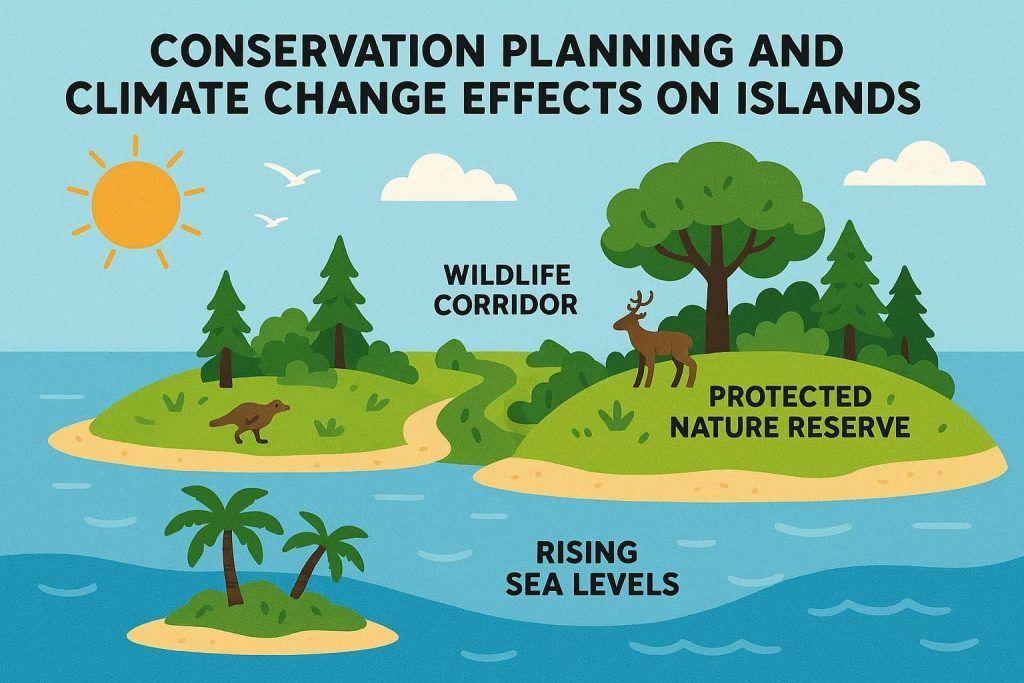
Island biogeography plays a crucial role in conservation planning, especially in the design of nature reserves and protected areas. Larger and well-connected reserves tend to support more species and lower extinction rates than small, isolated ones. Wildlife corridors are used to link fragmented habitats, allowing species to move, reproduce, and maintain healthy populations. These ideas guide protected area design by helping conservationists decide where reserves should be located and how they should be connected to maximize biodiversity.
Climate Change and Rising Seas
Climate change poses a serious threat to islands by increasing sea levels, altering habitats, and intensifying extreme weather events. Low-lying islands are particularly vulnerable to flooding and habitat loss, which can force species into smaller areas or lead to extinction. Rising seas and changing climates also create major challenges for species migration, as isolated island environments offer limited escape routes. Island biogeography provides valuable insights into predicting these impacts and developing strategies to protect vulnerable species and ecosystems.
Why Island Biogeography Matters to Geography Students
Understanding the applications of island biogeography in conservation and climate adaptation underscores its importance for geography students. Beyond theory, island biogeography provides practical insights into real-world ecosystems, making it a vital topic for both academic and field-based learning.
Island biogeography is highly relevant for exams and coursework because it links multiple aspects of geography, including species distribution, ecosystem dynamics, and human-environment interactions. Field studies on islands or habitat fragments allow students to observe these principles in action, enhancing hands-on learning and scientific observation skills. The study of islands also connects physical geography, such as land formation and climate, with human geography, including land use and conservation planning.
If island biogeography were not important, academic disciplines like botany, forestry, wildlife studies, and other environmental fields would not adopt it as a course or borrow its research techniques for their academic work. By exploring these interconnections, students develop systems thinking, allowing them to understand how isolated environments function as part of larger ecological and social landscapes.
In conclusion, Island biogeography is a key concept for understanding how isolation, size, and habitat affect species distribution and biodiversity. By studying the types of islands, the factors that influence colonization, and the impacts of humans and climate change, we gain insights that are essential for conservation, ecological research, and environmental planning.
Test your understanding and challenge yourself with our Island Biogeography Quiz to see how much you have learned and apply these concepts in a fun, interactive way.
Credible Sources for Island Biogeography
-
Island biogeography — Current Biology (ScienceDirect)
A scientific review explaining island biogeography concepts, species filters, and evolutionary patterns. Island biogeography primer (Current Biology)
-
A generalized model of island biogeography (Science China Life Sciences)
An academic article extending MacArthur and Wilson’s equilibrium theory and discussing speciation and endemism. SpringerLink
-
Endemism in the Hawaiian Islands — Wikipedia
An example of island endemism and how isolation drives unique species on islands. Wikipedia
-
Island biogeography academic book — Oxford Academic
Reference to a respected textbook on island biogeography, covering ecology, evolution, and conservation. OUP Academic
-
Island biogeography and landscape ecology — SpringerLink
Scholarly chapter on variables that influence island biodiversity, including island size and isolation distance. SpringerLink
-
Ecology/Island biogeography — Wikibooks
A structured educational overview of key concepts, including endemism and endemic regions.
Idara Eniang is a passionate digital creator and geographer dedicated to making geography simple, visual, and accessible.